


Shame often sits underneath a lot of avoidant behaviors. It tells us to hide – that we are the problem, and that the safest move is to keep the shameful part of ourselves a secret.
The hiding gives shame exactly what it needs to grow.
Asking if an emotion fits the facts is helpful to identify whether the emotion makes sense in the context of the current moment or past learning history. Even as much as my brain loves checking the facts, my body still loves focusing on feelings. Regardless of context – how annoying.
So when that happens, the work is deliberately acting opposite to the emotion’s action and expression urges. It’s easier said than done. And, it’s what makes valued action possible. The goal is feeling the emotion, recognizing that acting on it won’t help, and choosing the behavior that matches our values.
Opposite action applies when the emotion doesn’t fit the facts, or when it does fit but acting on the urge won’t get us where we want to go. Shame fits the facts when the behavior would cause rejection by a group whose acceptance we need.
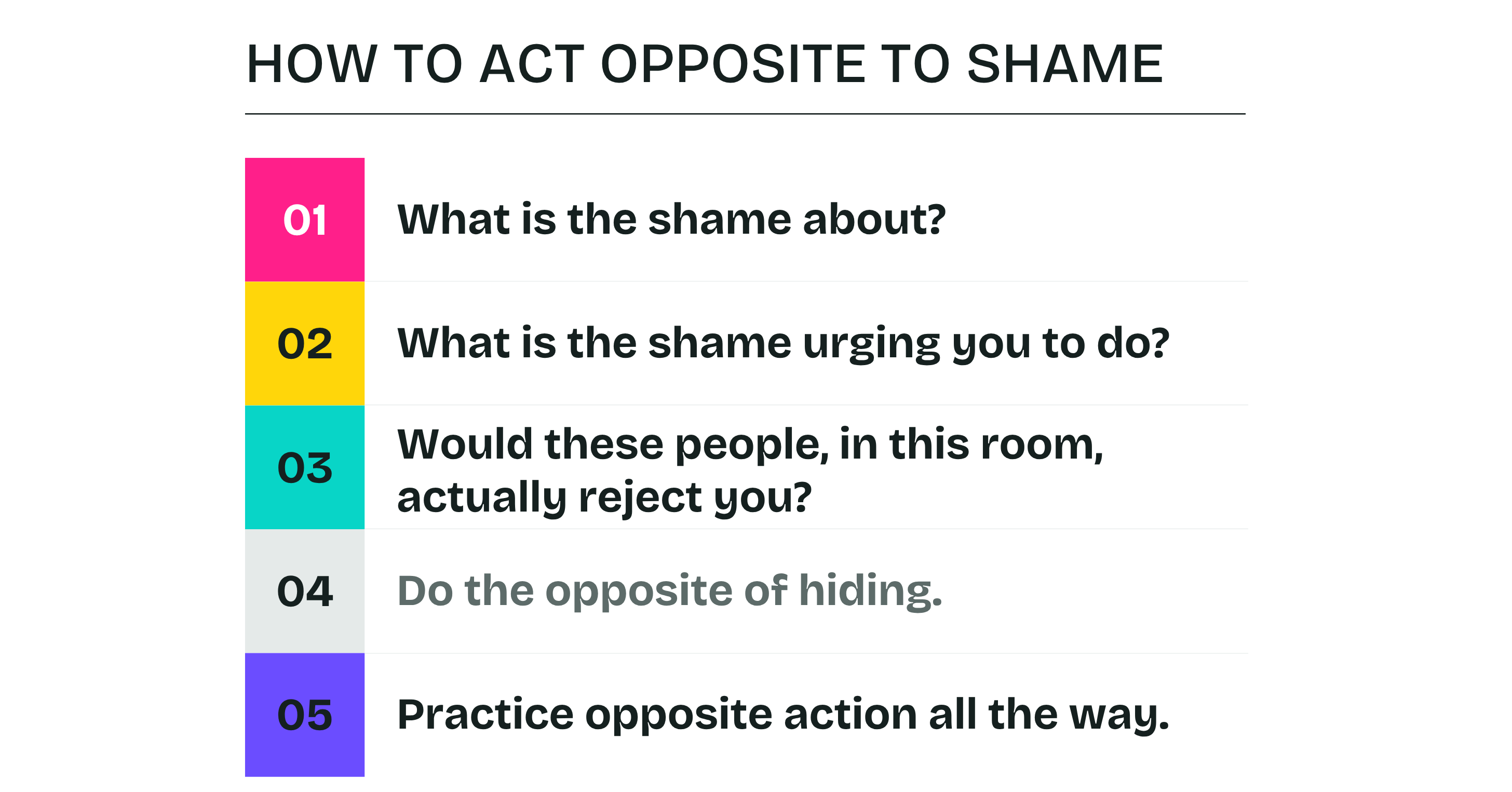
Identifying the effective action asks us to question if the shame is warranted with these people, in this room. Sometimes it is, and hiding is the effective choice. Knowing which situation we’re in is a skill.
When I came out, I felt lots of shame. Everything in me wanted to hide – to avoid the reality of my sexuality. And, I knew that avoidance would only reinforce the belief that my sexuality was wrong. Hiding blocks the thing that could update the belief: information about what happens when we don’t. We don’t learn that we’ll be okay while we’re making sure we never find out.
Checking the facts helped remind me that my shame didn’t fit with the people who matter. And, it did not stop the emotion from occurring.
So I practiced opposite action to live in alignment with my value of authenticity. I openly acknowledged my identity with trusted people. I made being lesbian a part of my personality. And I received more support from my community than I thought possible. I continue to do this repeatedly in new settings, finding that the more open I am, the more connected I feel.
The skill is practicing the opposite action all the way, repeatedly.
That means opposite posture, expression, thinking, and communication. It looks like keeping your head up, exuding confidence, saying the thing, and staying in the room long enough to find out what happens.
This is an active component in many effective interventions, like behavioral activation and exposure-based treatments. They target avoidance by helping people act opposite to what scares them and do the hard thing. The objective is the same in every modality – encouraging people to approach, with support, rather than avoid. It’s learning to confront the discomfort, finding out what happens, and gaining confidence in tolerating distress moving forward.
And. Shame operates not only at the individual level, but at interpersonal and systems levels as well. We learn what’s safe to reveal from the environments we’re in.
I think a lot about why DBT hasn’t become more mainstream. I previously discussed how this might partly be related to where it lives. And I think there’s more – some behavioral science approaches, like Acceptance and Commitment Therapy (ACT), have been translated to settings outside the therapy office.
In her memoir, Linehan discusses her own experience with mental illness and how that shaped her interest in helping others build their life worth living. When she was developing DBT, she was repeatedly told by scholars in the field to not disclose her personal history.
Linehan concealed her psychiatric history for most of her career. While she was working to help others effectively navigate their own shame, I have to imagine she was carrying her own. And, the field gave her a reason to stay quiet. A woman in the 1980s developing a treatment for one of psychiatry’s most stigmatized diagnoses, disclosing her own psychiatric history, risked having the treatment dismissed along with her.
It’s fascinating to think that the same hiding that protected Linehan’s treatment cost her decades of being fully known. She built a skill that teaches how to act opposite to avoidance for the purpose of building a life worth living, and the field she built it in made hiding the effective move for her.
This brings me back to Brené Brown’s work on shame – how it prompts protective behavior, impedes vulnerability, and limits connection.
And I have to wonder: what did it cost DBT when the person who built it was told to hide?
I don’t know how any of this shaped DBT’s translation to the broader public. And, I’m wildly curious about what a field learns to leave unsaid when the person behind a body of work is told to stay quiet.
Linehan finally opened up about her own struggles in 2011 because she “didn’t want to die a coward.” Brown argues that kind of courage requires vulnerability. The memoir that followed is opposite action all the way. And in it, she stated that she had a strong desire for belonging.
Linehan dedicated her career to helping people enhance their connection with themselves and others. And, one part of her own life stayed hidden for decades.
She got there. I keep wondering what it cost to take that long.