I’m fairly confident my partner is proposing in the next few weeks. I know for certain that she has the engagement ring she’s giving me – she kept me informed at all phases of the process, and I even went to FedEx with her to pick it up.
I love surprises. My partner loves them too – she just has a hard time keeping them secret. She gets so excited about what she’s planning that she wants to tell me ahead of time. That’s why I know when she’s proposing.
I’m so tempted to search for the ring. We picked it up on a trip visiting her family. We were sharing a room in her parents’ house, and during dinner, she took her family members to the room one-by-one to show it to them. I could have easily taken a “trip to the bathroom” to explore. Talk about tempting.
I’ve expressed my temptation to her multiple times. We’ve discussed it, and she’s fully aware that I can find the ring if I want. Then she reminds me of how much I want to be surprised.
I’m caught in a dialectic – loving surprises, and, hating not knowing.
This brings me to one of my favorite DBT skills: pros and cons.
You’re probably thinking, “I know how to do that.” And I’m sure you do. But the DBT pros and cons is fancy.
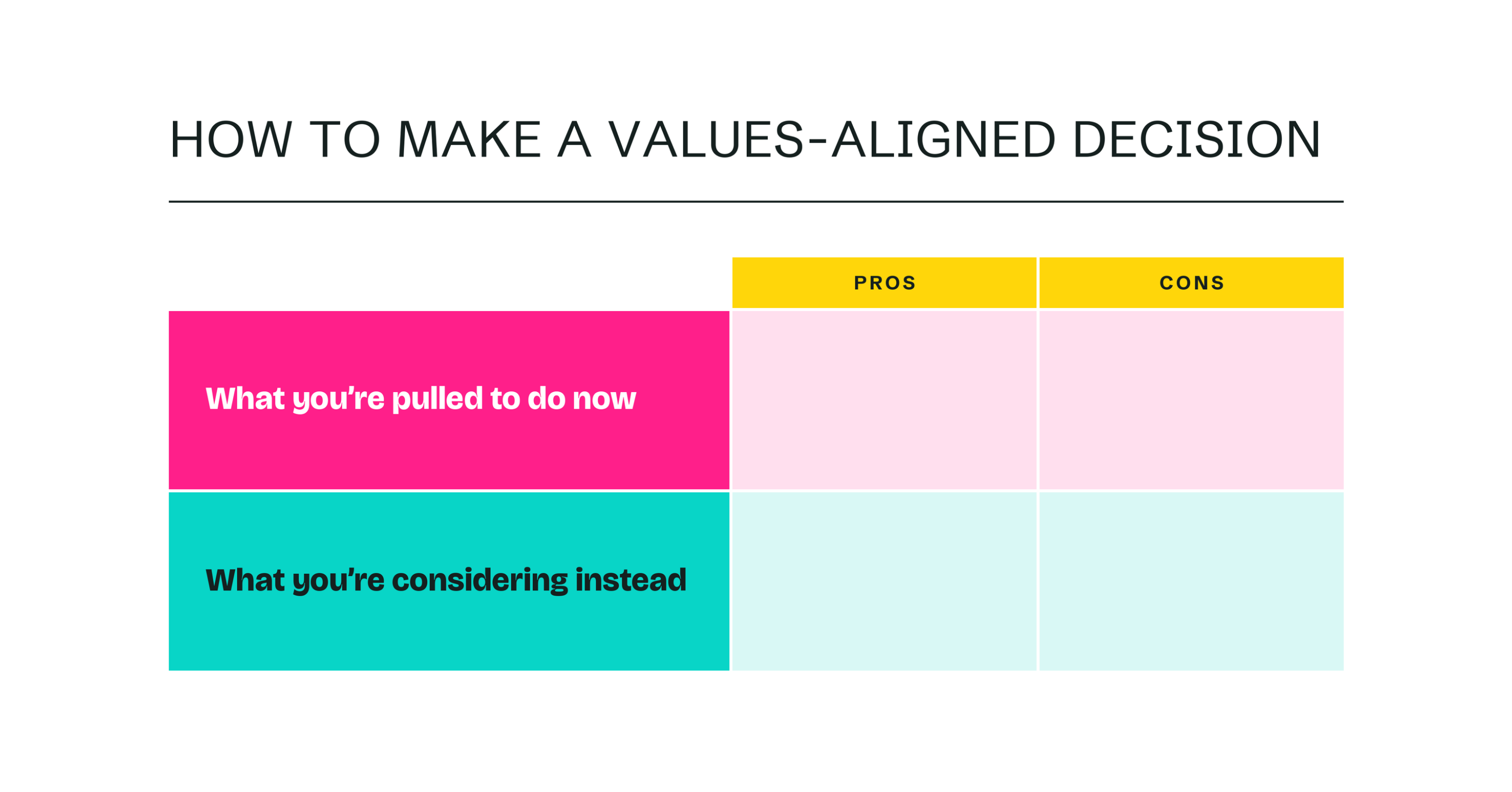
What makes it fancy is that the skill asks you to consider the pros and cons of two behaviors, side by side. It uses a quadrant to think through both 1) whatever you’re pulled to do now, and 2) whatever you’re considering doing differently.
This allows for comparing and contrasting the outcomes of two behaviors: giving in to the emotion urge, or tolerating the distress associated with not giving in to it.
In my case, this is thinking through the pros and cons of both snooping and waiting.
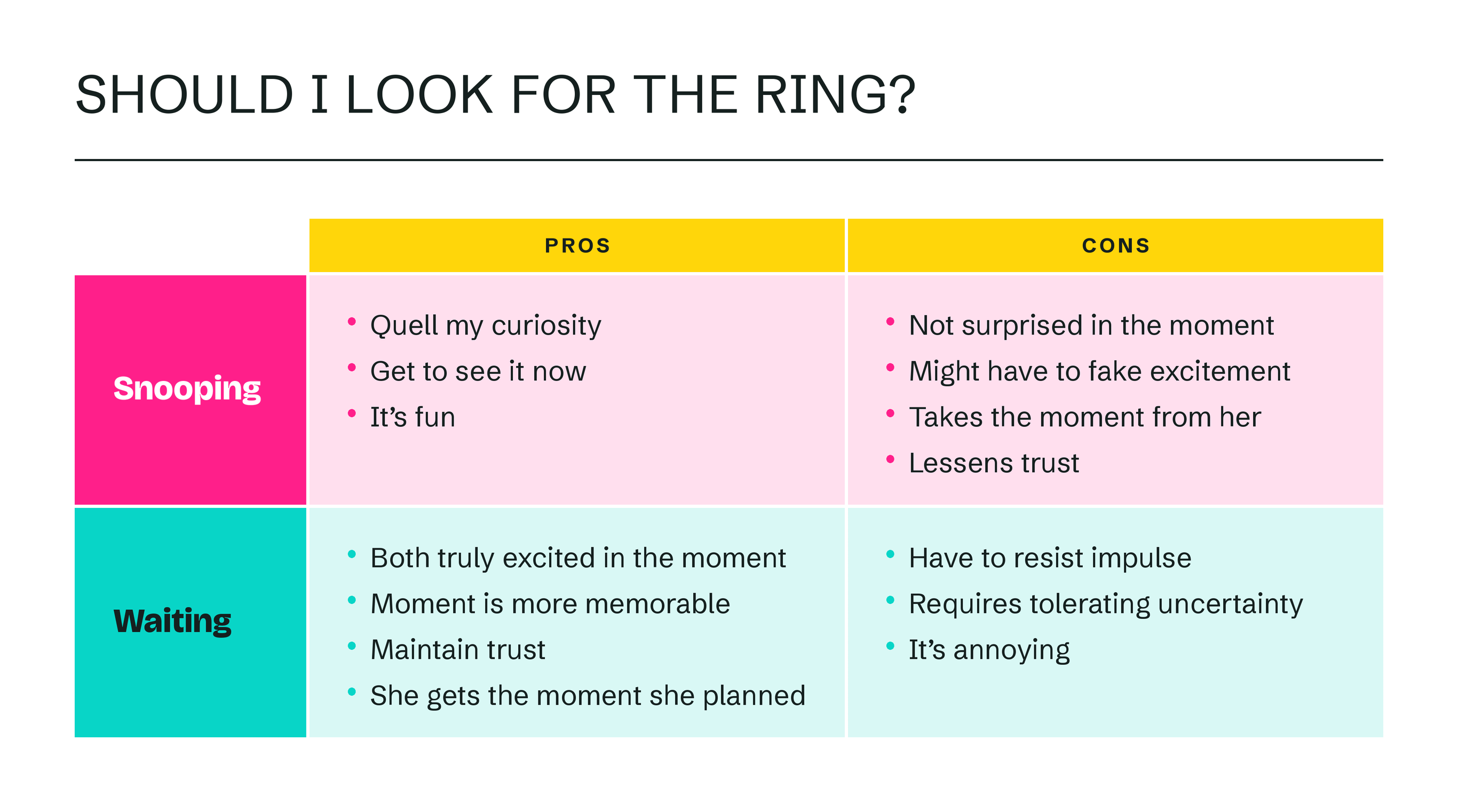
Once the quadrant is completed, I encourage people to take a step back, observe all of it at once, and see what stands out. What usually emerges is that the behavior that feels hardest in the short-term is more aligned with what matters to us in the long-term. Giving in just feels better sooner.
My curiosity is not a flaw. The ring is less than twenty feet away, and I can’t imagine I’d look for more than ten minutes without finding it. My temptation to know what I’ll (hopefully) wear forever makes sense.
The work is asking whether acting on that curiosity is aligned with my values.
As much as I want to know what the ring looks like now, I’m more looking forward to seeing it the moment that she’s planned. I value the moment she’s intentionally creating for me more than the chance to see the ring in isolation. Going through the DBT version of pros and cons when she first started telling me about the ring helped me identify that. It’s how I sat through that dinner.
Pros and cons is hardest to do in the exact moment when it’s most useful. I always encourage people to write out their pros and cons in advance, when they’re thinking clearly, and when they’re anticipating feeling pulled in another direction in the future. Then, take a picture of it, favorite it, and review it when the urge toward the emotion-driven behavior rises.
Knowing what you value and remembering it under pressure are different.
Reviewing the list doesn’t tell you what to do or how to act. It highlights what behavior is more aligned with your values in the long-term, which is often different from what you’re pulled toward in the moment. And, the values have to be yours. Not your partner’s, not the ones you would say if someone asked. The ones you still choose when nobody else is watching.
I know I can search for the ring – it’s just not what I want in the long-term. And, that gap is why it’s helpful to write it out. I used this on a decision where getting it wrong costs me a spoiled surprise, not a marriage. A skill works under pressure when you’ve already practiced it when there wasn’t any.
The ring is just a small example of something that shows up everywhere. Whether to quit the job, end the relationship, have the hard conversation, stand up for what you believe. The pull feels immediate, and the cost feels out of sight. The skill makes the cost visible in the moment when acting on the emotion seems so much more appealing.
I’ll never stop hating the not knowing. I’ll continue wanting to look every day. And, waiting is how I navigate the messy space between wanting to know and wanting to be surprised.
I can hate it, and, still choose it.