


Responding to the avoidance problem requires rethinking how we view emotions. We need to shift from seeing them as something to avoid – push down, distract from, or outright deny – to something to accept.
Remember the options for responding to any problem: 1) solve it, 2) feel better about it, 3) tolerate it, or 4) stay miserable. Avoidance is often what keeps us choosing the fourth. The first three all require regulating emotions skillfully.
This starts with recognizing that emotions aren’t something to fear. They come from somewhere, whether or not we’re aware of it. Each serves a function.
They can be uncomfortable. And, does anyone actually die from experiencing an emotion intensely? Have you ever had one persist endlessly? All emotions rise, peak, and then fall. None lasts forever.
The more we fear emotions, the more we try to avoid them, and the more scary they seem (remember the cycle of avoidance?). Which is counterintuitive to what most of us learned – that hiding big emotions keeps us from seeming “weak” or “sensitive.”
If we’re willing to view emotions differently – to think about them dialectically – we can move from being controlled by them to regulating them. We can see them as something to learn from.
Emotions are important sources of information that evolved to help solve problems necessary for survival. They serve three functions:
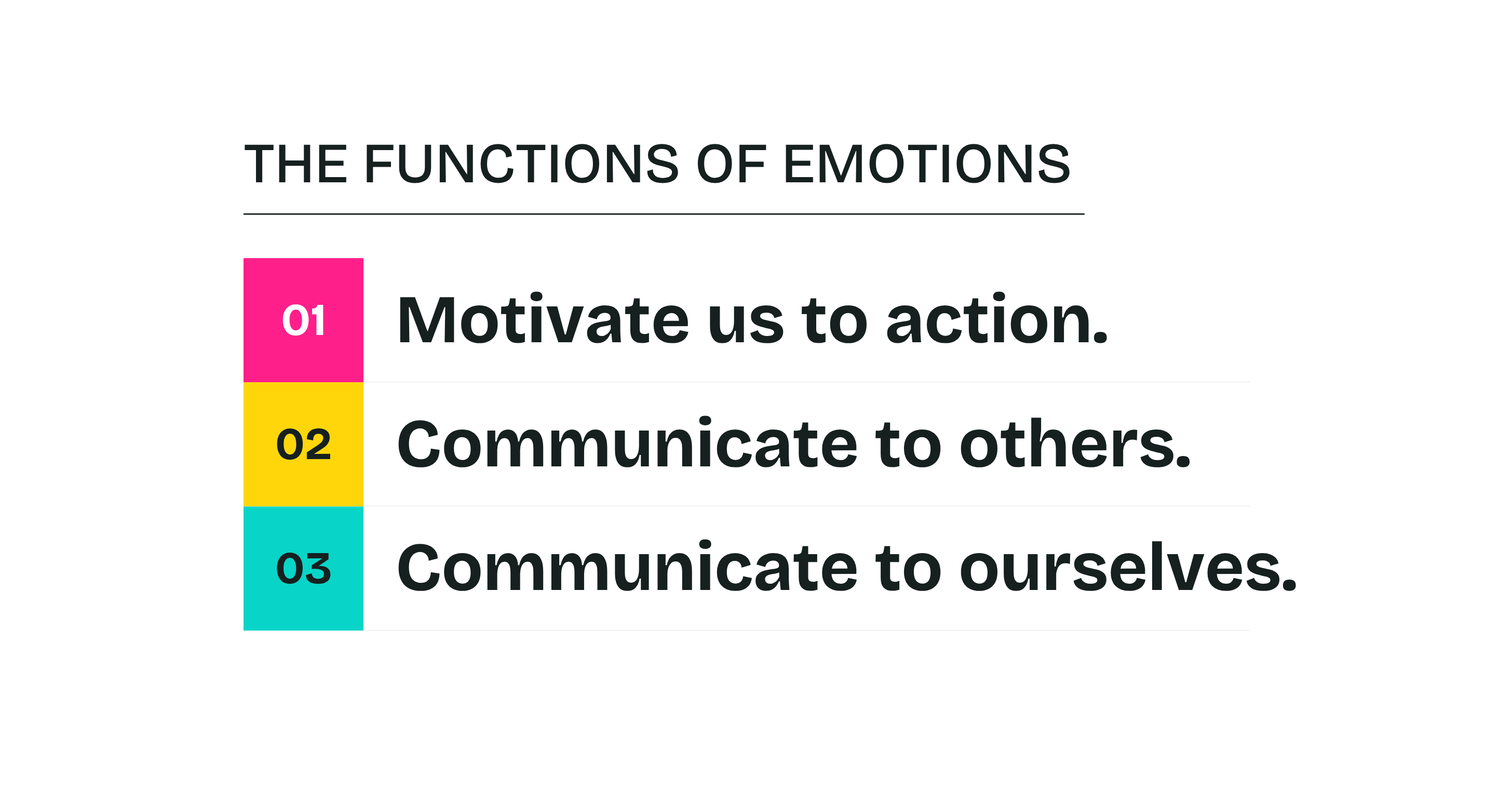
Emotions motivate us to action. They prepare us for action and save us time when it’s limited. Each is associated with an action urge that arrives before deliberation does.
Consider hiking in the mountains when a grizzly bear emerges from the trees. You don’t have time to think through your next steps. Fear moves you before you decide to move.
We’re no longer encountering life-or-death situations as frequently as humans once did. Which is great, and in my opinion, very much preferred. Our biology just hasn’t caught up, so we still overestimate danger and underestimate the likelihood that we’ll be okay. Fear moves us away from situations that might be neutral, or even beneficial.
I recently went to an event to practice pitching my idea that we need behavioral science now more than ever. Everything in me wanted to run out of the room. My anxiety made sense given the vulnerability required. And, my safety was very much not at risk.
I told the group I was feeling terrified and made a joke about practicing what I preach. Others said they felt similarly. I stayed in the room, gave the pitch, and received constructive feedback. Even better, people seemed genuinely interested in what I had to say.
Emotions communicate to others. Our facial expressions often communicate faster than words. These nonverbals influence others, whether we want them to or not.
When what we show doesn’t match what we say, people rely more on what they observe than what they hear. They translate it through their own assumptions, which is often where misinterpretation starts.
Think about the last time you said you felt “fine” when you felt anything but. Chances are your face communicated something differently, leaving what you actually felt up for interpretation. Others might have concluded you were mad at them or disliked them.
Your reality might have been completely different. Maybe you had a stomach ache because you were constipated, and you didn’t feel like sharing that information. Completely valid. And, hiding it left the people around you guessing.
Most of us learned to hide for a good reason. Somewhere along the way, saying the real thing was costly, and “fine” kept the peace.
And, what we hide quietly teaches people what’s safe to bring us. The less they bring us, the less we bring them, and the more each of us assumes we’re the only one.
Hiding costs us something that reliably helps. Emotions are often easier to regulate when they’re met with acceptance than when they’re managed alone.
Emotions communicate to ourselves. They’re signals about what’s going on, and they often pick up details registered outside of our awareness. Our personal history shapes when, where, and how intensely they show up, which is why they typically make sense.
The issue is when we start treating emotions as facts and use them as evidence to support existing beliefs. What was accurate before might be outdated now. We need to check them against the current context.
Many of us carry a belief that we’re not “good enough” in some capacity. There was likely a time when that conclusion was understandable, and it may even have motivated us to develop new skills. And, if every experience of shame gets filed as more evidence, without checking the facts, we cause ourselves unnecessary suffering.
Naming the emotion is the first step. And the label itself is regulating – putting our feelings into words measurably lowers physiological activation.
Being specific helps: “I feel afraid of failing in front of strangers” does more than “I feel bad.”
Everyone needs skills for turning toward emotions rather than away. This means giving ourselves permission to feel the emotion while staying curious about why it’s there. Examining the emotion without feeling it is a fancy way to avoid it.
Marc Brackett, who founded the Yale Center for Emotional Intelligence, estimates that less than 10% of us are ever taught these skills. Ethan Kross, who directs the Emotion and Self Control Laboratory at the University of Michigan, admits that those of us who study emotion regulation don’t often teach it.
That’s what I’m here to do. To teach people how emotions show up, and how to regulate them in line with their values.
The first skill is turning toward emotions long enough to ask what they’re signaling, instead of automatically doing what they’re urging.