


If you ask a therapist about their thoughts on coaching, be careful. You might end up listening to a tirade about all the problems with coaching. I know this because I’ve given the tirade.
The main issue many therapists have with coaching is that anyone can call themselves a coach. While coaching certifications exist, they vary widely in how much training, supervised practice, and accountability they require – and nothing regulates the title.
As someone who spent six years in graduate school, and another two years in postdoctoral training, it’s quite frustrating that people without an advanced degree can call themselves a coach and often charge more money doing so. Some of that frustration is a concern about accountability, and, some of it is ego.
I experienced a bit of a “mid-career crisis” this year, and a friend connected me with someone pursuing a coaching certification who needed a client willing to participate in coaching for supervisory purposes. I jumped on the opportunity – I’m not someone to say no to anything that furthers self-exploration or personal growth.
I found working with this coach-in-training not entirely different from some of the work I do as a therapist. They explored my feelings, challenged my thinking, and helped me identify action steps for making values-aligned change. Around the same time, I was developing my theory of Regulated Leadership, which is grounded in behavioral science. And, in an interesting turn of events, I started piloting it through executive coaching. Now, I offer both therapy and coaching.
Fast forward to my MBA program, which includes executive coaching as part of the curriculum. I now have my own executive coach – one that’s not in training, and has decades of experience doing this work. She further confirmed that what I do as a therapist is quite similar to coaching. In our first meeting, I cried more than I had in my last several sessions with my therapist combined.
Throughout all of this, my regular podcasts and reading material seemed to talk about coaching more and more (the algorithm must know what both infuriates and interests me). My interest in the similarities and differences between coaching and therapy gradually increased.
This led me to explore the public conversations and scientific publications on the topic. I’m not going to do a literature review here, and, what stands out is how coaching and therapy appear more similar than different.
The usual lines between them are in the wrong place.
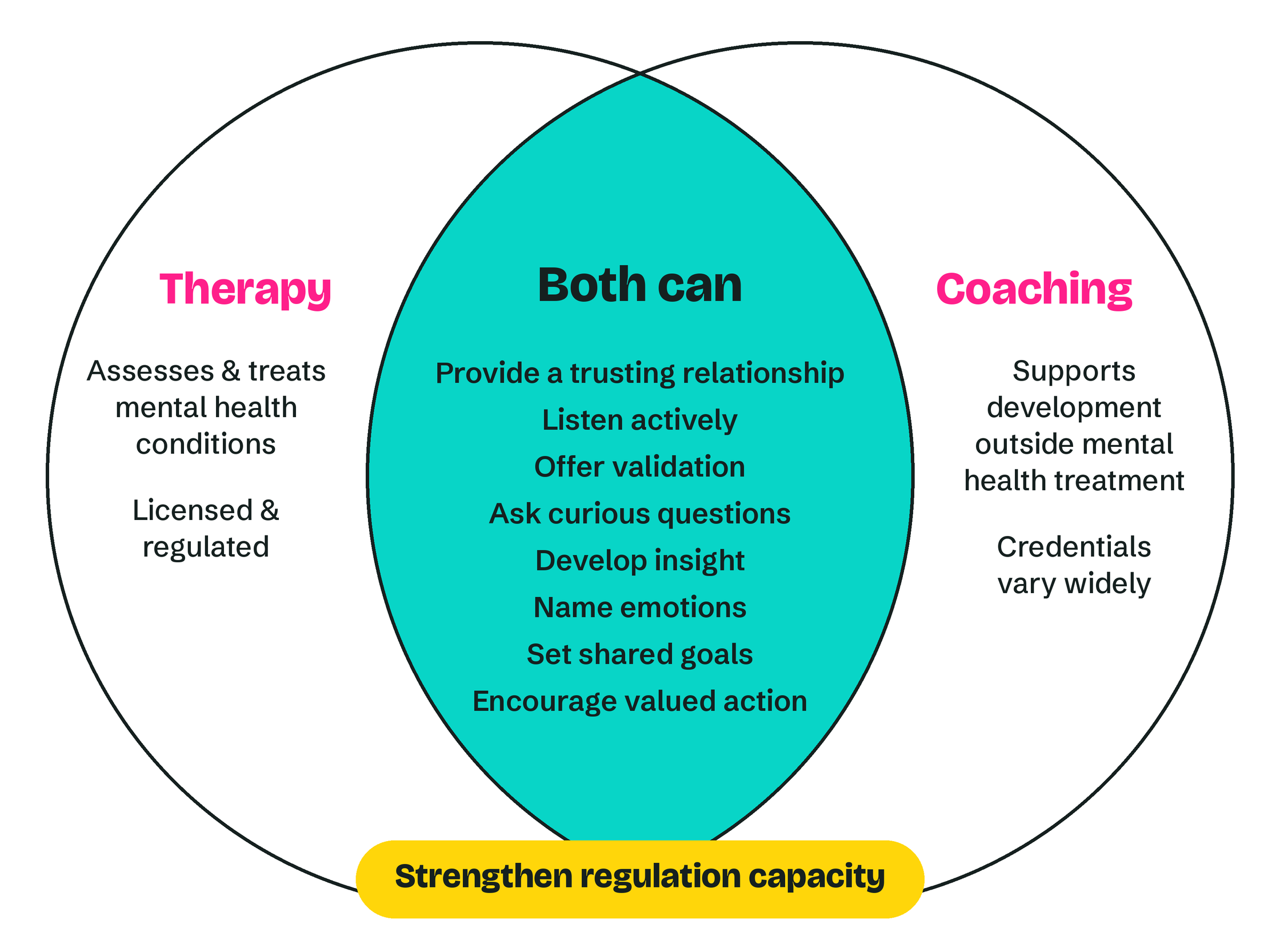
Both focus on active listening, validating another’s experience, and asking questions to foster deeper insight. Both seek to provide an open and nonjudgmental space for being vulnerable with someone else.
Both function as a mechanism for strengthening regulation capacity – helping people stay present, navigate emotions, think flexibly, communicate clearly, and take values-aligned action when pressure rises.
Therapy is often viewed as more “past focused,” while coaching is viewed as more “future focused.” As a behavioral psychologist, and specifically one specializing in dialectics, I find this description inaccurate to the therapy I provide.
I always explore someone’s past upon meeting them. And, the purpose is to better understand the function of present behavior. This allows me to validate why behavioral patterns make sense, which increases space for openly talking about what otherwise might feel shameful. Once I understand what I am working with, I don’t explore the past any more than necessary. Rather, I focus on what’s happening now, and how to help people do better moving forward.
I work in the space between the past and the future – the present, and how we can attend to it effectively, and in a way that’s consistent with our long-term values.
Another common distinction is that coaching typically focuses on “well-functioning” individuals, and therapy typically focuses on “low-functioning” individuals. As someone passionate about how judgments impact our thoughts, feelings, and behaviors, I find this description problematic.
I was trained as a counseling psychologist, with an emphasis on optimizing strengths, enhancing well-being, preventing further distress, and fostering growth. So my educational background makes the line between therapy and coaching even fuzzier, as counseling psychologists don’t exclusively work with pathology. I’ve worked extensively with severe dysregulation, and, I’ve also helped people develop existing capacities and function more effectively.
Those tasks aren’t mutually exclusive.
Not to say this narrative is entirely inaccurate – if someone is experiencing a clinically significant mental illness, therapy is most appropriate. A coach is less likely to have the skills to navigate complex mental health concerns.
And, therein lies the problem – this framing makes seeking therapy seem like there is an “issue” to be “solved.” This can discourage people from pursuing it.
Sorting people this way is thinking non-dialectically – in extremes. We’re also merging separate questions – how well someone is functioning, and whether they meet criteria for a diagnosis – into one. People can be “well-functioning” and meet criteria for a mental disorder, and, people can be “low-functioning” and not meet criteria for a mental disorder.
Realistically, many people live in the messy space between “low-functioning” and “well-functioning.”
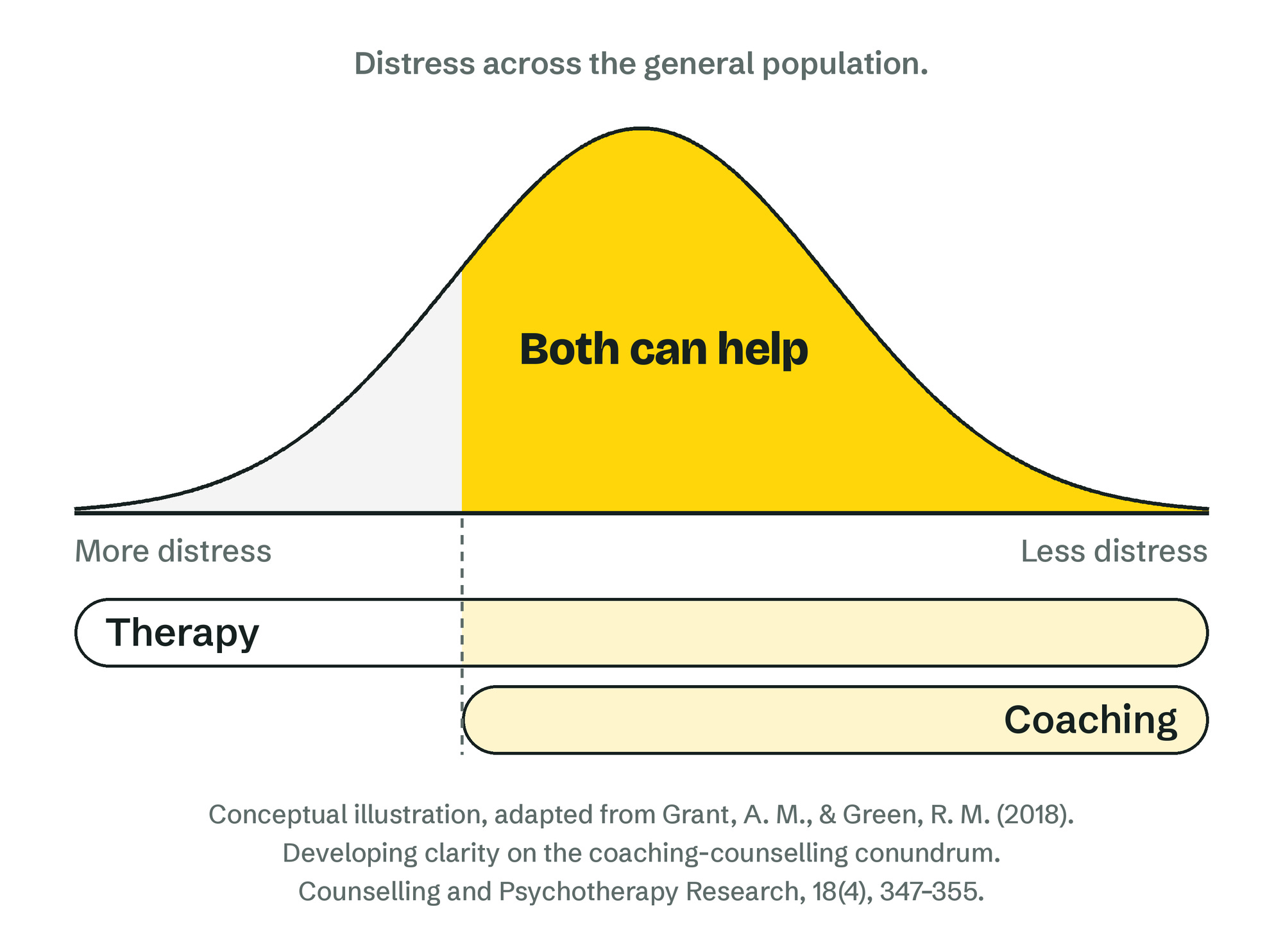
The people who see coaches and the people who see therapists overlap more than the labels suggest.
On a personal level, seeing this theme emerge in the literature had me questioning myself: I’m in weekly therapy, I find it useful, and with my knowledge of the current diagnostic categories, I don’t think I fit into one. So what does that mean about me, if I’m rather “well-functioning” (or so my therapist says), and, in therapy?
Thankfully, I know how to check the facts, so I don’t feel ashamed about being in therapy (clearly). And, when therapy is framed for “low-functioning” people, where are people more likely to gravitate? I know what I would prefer.
I think a more helpful dividing line is the purpose of the work: whether the work involves assessing and treating mental health conditions, or supporting development outside that role. When someone is experiencing a clinically significant mental disorder that causes impairment in daily life activities, medical stability, or physical safety, therapy is the most beneficial option.
Coaching ethics establish a similar boundary – the International Coaching Federation asks coaches to work within their level of competence and direct clients to different professionals when necessary. And, coaching outcome research also suggests positive impacts on the clients’ mental health, even when not directly addressed.
The reality is that many people can benefit from therapy regardless…I now think this about coaching as well 🤯.
The research on therapy outcomes consistently finds that, across therapeutic approaches, the quality of the working relationship predicts change. That includes how much you connect with, feel seen by, and experience understanding from the person sitting beside you – and whether you agree on what you’re working toward. The research on coaching demonstrates the same pattern.
I’m rethinking my past beliefs about coaches. Sure, they might have different learning experiences than me, and, who am I to say those experiences aren’t worthwhile? Because anyone can call themselves a coach, the title alone says little.
When deciding whether to seek support – whether with a coach or therapist – I think the more important factors to consider are their background, approach, and how they think about change.
That helps narrow who might be helpful for someone to work with, and, what’s also important is what happens when you enter the room: whether you feel safe enough to open up with them, authentically.
I think therapy and coaching are more similar than different.
And, similarity in the conversation doesn’t erase differences in training, scope, and accountability.