


Many of us aren't great at handling problems. Which is itself a problem, because they’re endless.
Our options for responding are not. There are four:
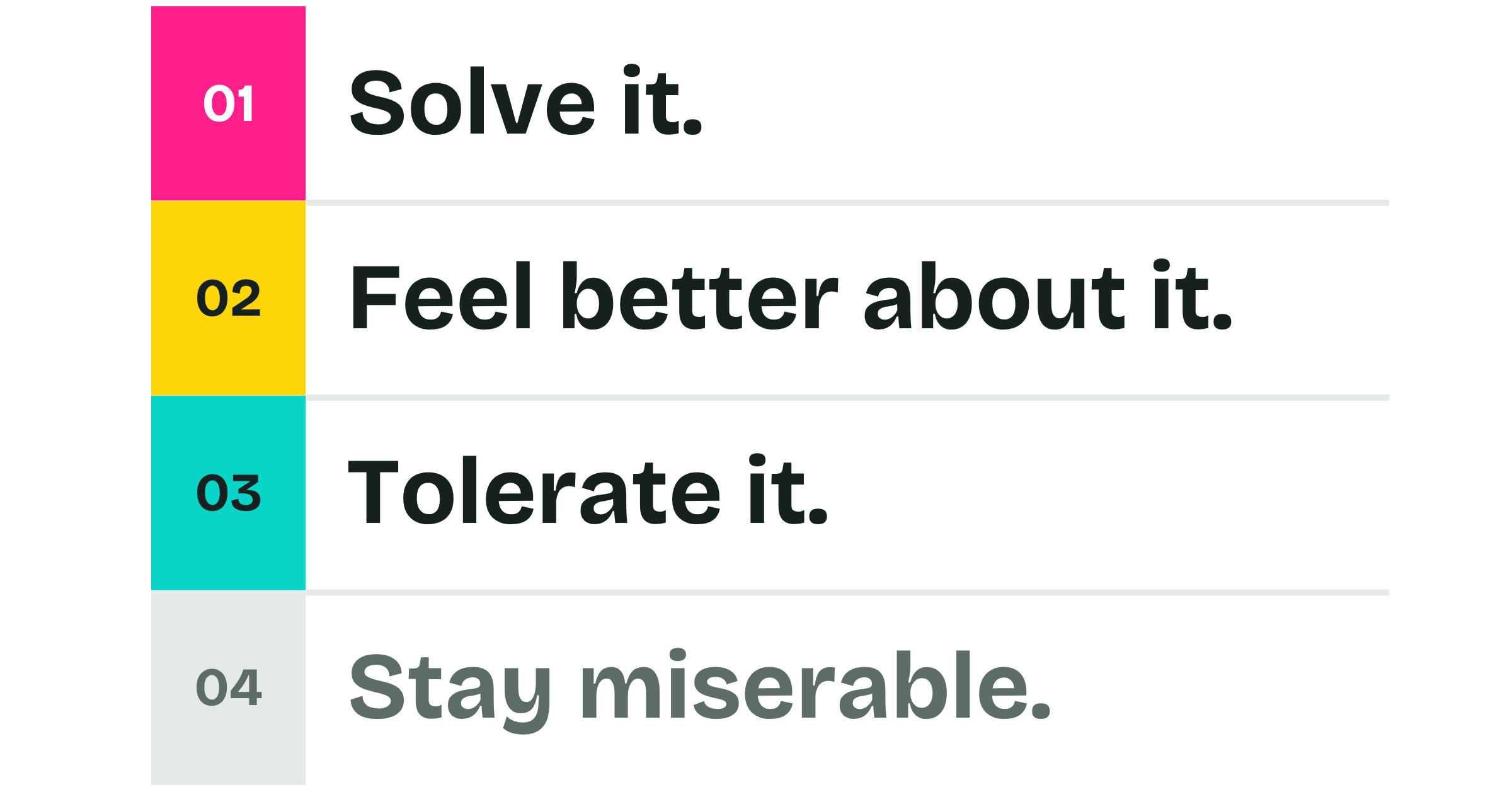
Marsha Linehan outlines these early in the DBT skills manual. Knowing these options makes them available. You get to choose how you respond.
Let me show you what I mean. My partner has a habit of leaving half-finished cans of seltzer water around the house. She warned me about this quirk and expressed little desire to change. After moving in together, I realized the extremity of the issue.
It’s standard to see five or six cans sitting on her nightstand at any time, and there’s always a variety of partially filled cans in her car (or mine, when she borrows it). The cans scattered around our home irritate me. What are my options? The same four everyone has.
First, you can solve or modify the problem. This starts with factually describing the situation and identifying the specifics of the problem itself. Then, brainstorm ways to effectively solve the problem in line with your values.
Once you identify a viable solution, mindfully take action and evaluate what happens. If you’re not satisfied with the outcome, revisit alternative solutions brainstormed earlier and try another strategy. You can also leave the problematic situation for good. Sometimes it’s the most values-consistent option available.
In my case, brainstormed solutions might include telling my partner directly that the cans bother me (yes, she warned me), expressing appreciation whenever she cleans them up, or nagging her whenever they are left out. Naming it and expressing appreciation are most in line with how I want to treat someone I love, so it’s where I would first take action. And, I could decide the can issue is too annoying to deal with and move out (spoiler alert: it’s not).
Next, you can feel better about the problem. This starts with observing the emotion the problem elicited. Just acknowledging and naming what you’re feeling helps lessen the intensity.
Then, notice the automatic judgments, beliefs, or assumptions about the problem that emerged. Examine the accuracy of your thoughts and identify whether they are based on reality. If the emotion or its intensity doesn’t fit the facts – or acting on the emotional urge would make things worse – change your behavior. Act opposite to the urge, and your emotions will change as a result. The problem remains, the distress decreases.
Even with reinforcement, my partner’s behavior might not change. If she continues to leave the cans around the house, I can decide to regulate my emotions in response. When I notice feeling frustrated, I can observe it, check whether the intensity fits the facts of the situation, and/or act against my urge to snap or withdraw and approach her calmly.
Third, you can tolerate the problem by changing your relationship with it. Sometimes you can’t solve the problem or feel better about it. What you can do is radically accept the facts and your emotional reaction.
This involves fully seeing reality as it is and letting go of fighting what can’t be changed. It includes validating that uncomfortable emotions make sense in the context of painful problems. This allows for effectively tolerating uncertainty, complexity, or ambiguity. The problem remains, the suffering – or what you add to the pain – decreases.
Even with emotion regulation, I still might regularly feel anger toward my partner’s messy behavior. Instead of pushing for change, I can accept this as one of her quirks, recognizing that if I want to be with her, this behavior is part of the package. I can validate my irritation without negatively impacting our relationship. I can notice my distress and learn how to interact with it more effectively. And over time, I expect the half-empty can situation to generate less frustration than it does now.
Finally, you can stay miserable. You can do nothing, or make things worse. Zero skills required!
I can keep feeling frustrated every time I see a half-empty can, keep begging my partner to change, and keep getting limited traction. I can decide to stay perpetually frustrated.
The seltzer cans aren’t a huge deal, of course. And, the same four options apply to the problems that cut deep.
The first three options all require behavioral skills to tolerate the tension between acceptance and change. Knowing our options and skillfully responding when our nervous system is activated are two different things. That’s why practice is essential.
The fourth option is different. Staying miserable is still a response, although it rarely feels like a choice.
It’s the default when we lack – or cannot access – the behavioral skills. Each time we practice another response, the default becomes less automatic.
Accepting that a problem exists is the prerequisite for responding to problems effectively. Solving, feeling better about, and tolerating a problem only happen when we acknowledge it.
We’re often reluctant to view problems accurately, which makes sense – clearly seeing something painful is its own kind of pain. And, problems we won’t see clearly leave us responding to the reality we wish existed instead of the one that does, which only creates more problems.
Many of the problems we encounter are outside of our control. What remains in our control is how we choose to respond.
Accepting what we can't control, and choosing to skillfully respond to what we can, is how we move closer to experiencing life as worth living.