


Understanding why we avoid offers validation and opens space for change. I know why I don’t want to give someone feedback – I don’t want to feel guilt for potentially hurting their feelings.
And, understanding alone isn’t enough. If it were, avoidance wouldn’t be so hard to stop.
So my next question: if avoidance is widely recognized, why does it persist?
I think it persists for two seemingly opposing reasons: there are times when avoidance clearly helps, and other times when it clearly doesn’t. In either situation, it can bring immediate relief. It’s dialectical.
There are also many times when the outcome is ambiguous and we have to make our best guess about how to act.
When ending relationships, keeping distance is typically a smart move. And, separation from someone who knows you well is difficult. The fear of not being known like that again, or the thought of having to rebuild that kind of connection, feels huge and uncertain. Even knowing the legitimate reasons for parting, the pull to return to what feels safe is strong.
Maintaining some distance allows for standing by the decision, effectively experiencing grief, and appropriately moving forward. It might look like avoidance, yet the function is to create room to feel the discomfort without reversing a values-aligned decision.
In my own life, it’s easy to look back now and see that distance helped. Yet in the moment, the outcome was unclear. Given how often we misjudge the likelihood or intensity of threat, avoidance can also work against us. That makes the “right” action hard to determine in advance. What’s helped me tolerate that uncertainty is opening up to others and asking for support.
Whether avoidance protects or pulls us away from our values, it starts the same – with emotions, often fear or shame. These emotions carry important information. They can function to protect us from harm or social exclusion. They help preserve our safety or belonging.
Fear usually motivates avoidance first. When we view internal and external experiences as potentially threatening to our physical, psychological, or social safety, we want to abandon ship. This makes complete sense. If we start judging ourselves for being afraid, or anticipate judgment from others, shame emerges. It’s a secondary emotion that often keeps avoidance going.
Avoidance often provides temporary relief. We eliminate or reduce contact with something aversive. The moment we decide to avoid, our distress often drops.
It works – that’s the catch. The relief is reinforcing. It teaches us to choose avoidance the next time distress appears.
The next encounter brings up memories of the original distress and the relief that followed avoidance. We might consider responding differently, yet imagining continued contact with the distress intensifies it. Avoidance becomes even more appealing. So we avoid it again, strengthening the cycle.
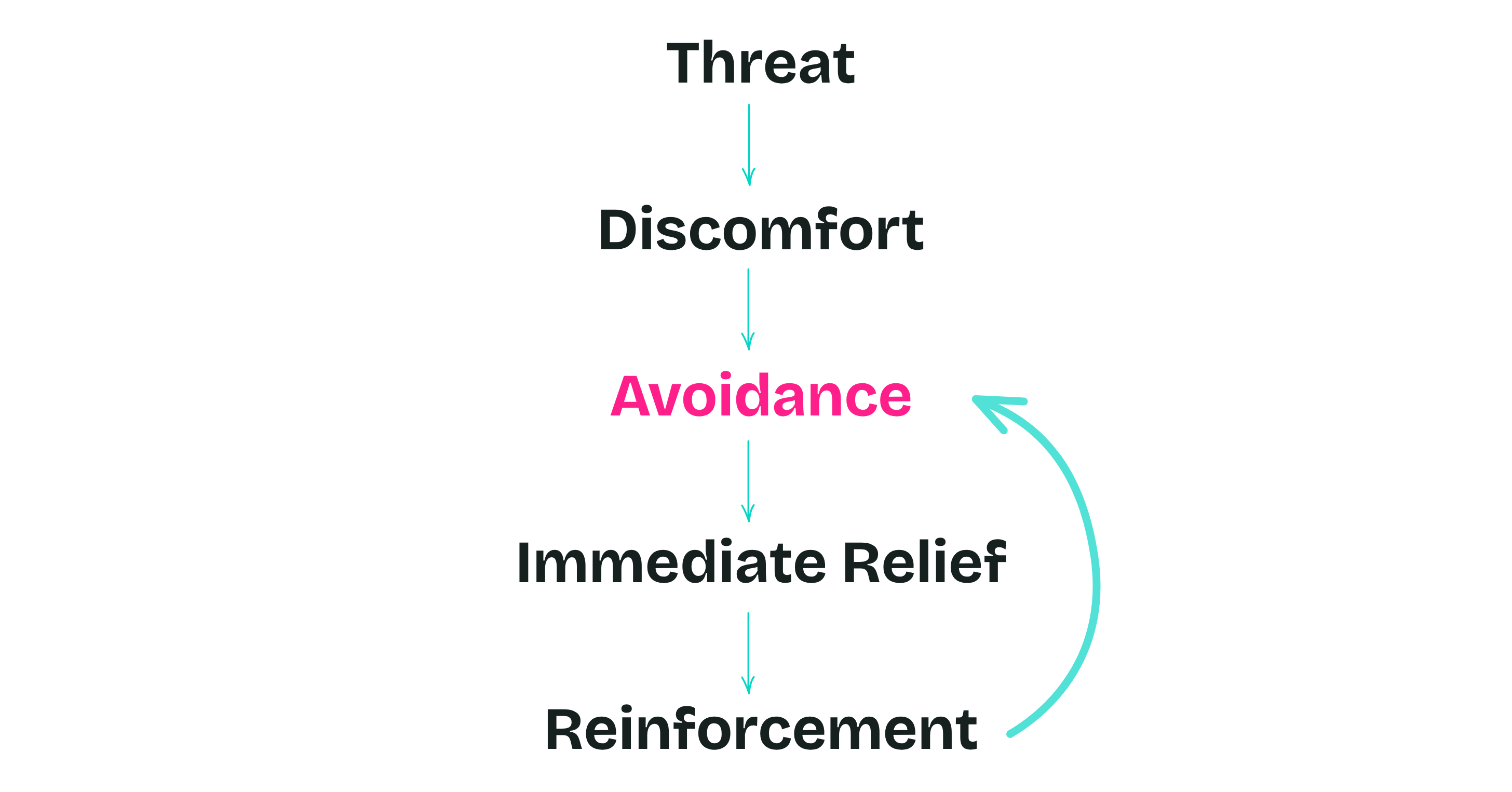
As this continues, we miss out on learning that we can tolerate discomfort. We lose the opportunity to learn that distress rises, falls, and eventually ends. We lose the chance to learn that distress can be painful without being permanent or intolerable.
We get into trouble when the effectiveness of avoidance is unclear and we respond automatically. Problems emerge when we act on the emotion’s urge without checking whether the emotion, or its intensity, fits the facts.
When we automatically follow the urge to avoid, without checking the facts or evaluating likely consequences, we can disconnect from our values. What reduces discomfort in the moment prolongs it over time.
The more we’re willing to face discomfort, the less it will take control.
And the more we invite others to sit with us in it, the less daunting it will seem.
The trouble is that discomfort is becoming easier to escape, so we’re getting less practice tolerating it. More on that next.