


Listening improves relationships. As Stephen Covey put it, listening to understand builds trust.
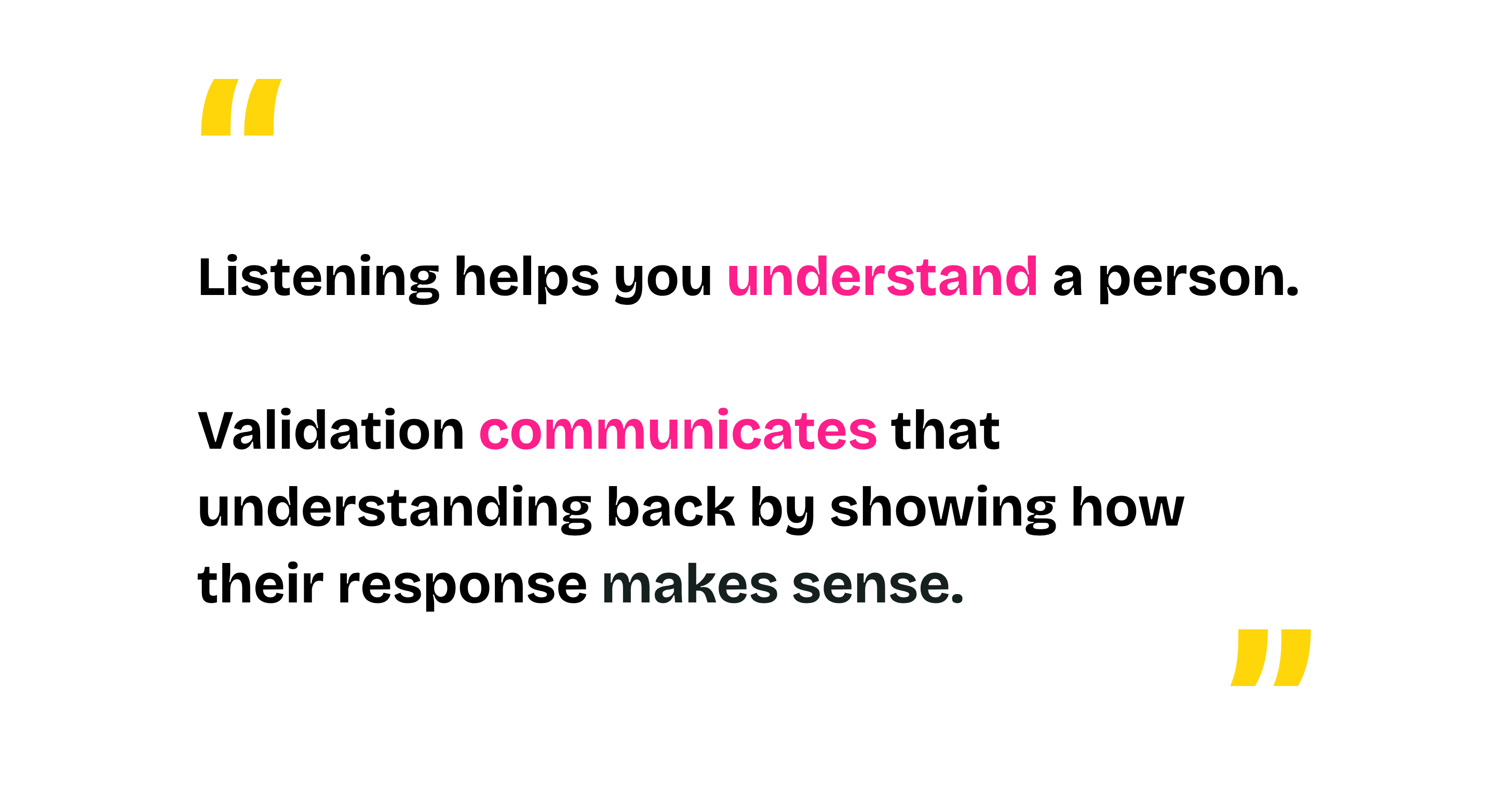
And. Understanding alone isn’t enough. The other person has to know you understand.
Think about the people you’re close to. Why are you close to them? Do you feel that they understand you, at least somewhat?
My closest people communicate that they understand what I’m saying. Yes, many of them are psychologists and know validation well. And, it’s fascinating what the simple sentence “yeah, that makes sense” conveys. I hear it (and say it) all the time. I’m not sure I’ll ever get sick of it.
DBT encourages explicitly asking whether someone wants validation or problem-solving. This is because we so often jump to the latter. Which makes sense (there it is), because when we care about someone, we want to do whatever we can to take their pain away. And, offering solutions without first validating someone’s experience can feel minimizing or dismissive.
I know this well. My ex-husband went straight to problem-solving all the time. He jumped to what I needed to do rather than expressing understanding. As a physical therapist, his answer to my problems was always to exercise more. As an eating disorder therapist, that was the opposite of what was helpful.
I don’t think people do this intentionally. Even knowing all this, I still jump to problem-solving all the time. Multiple times a week I find myself saying, “Whoops, I just went straight to problem-solving. I apologize.” And then I validate.
I just get so excited when I feel like I know a helpful solution and want to dive right in. And, the impact is often the opposite of what I want: it pushes people farther away or makes them less likely to open up to me again. Asking whether someone wants validation or problem-solving helps provide the support they actually crave and furthers connection.
Validation is essential to developing and maintaining relationships.
It communicates clearly that you are paying attention to someone, understanding what they are conveying, and seeing what makes sense in their perspective.
Accurate validation means searching for what we’re missing, asking more about another’s experience, and staying open to what we find. It’s rethinking our assumptions and allowing what we learn to expand our views.
Validation is not agreement, approval, or reassurance.
We can validate the why without validating the what. What we validate, people do more of. So we need to look for what is understandable in someone’s response – the emotion, thought, or action – and communicate that understanding without reinforcing an inaccurate interpretation or ineffective behavior. The why often makes sense even when the what needs to change.
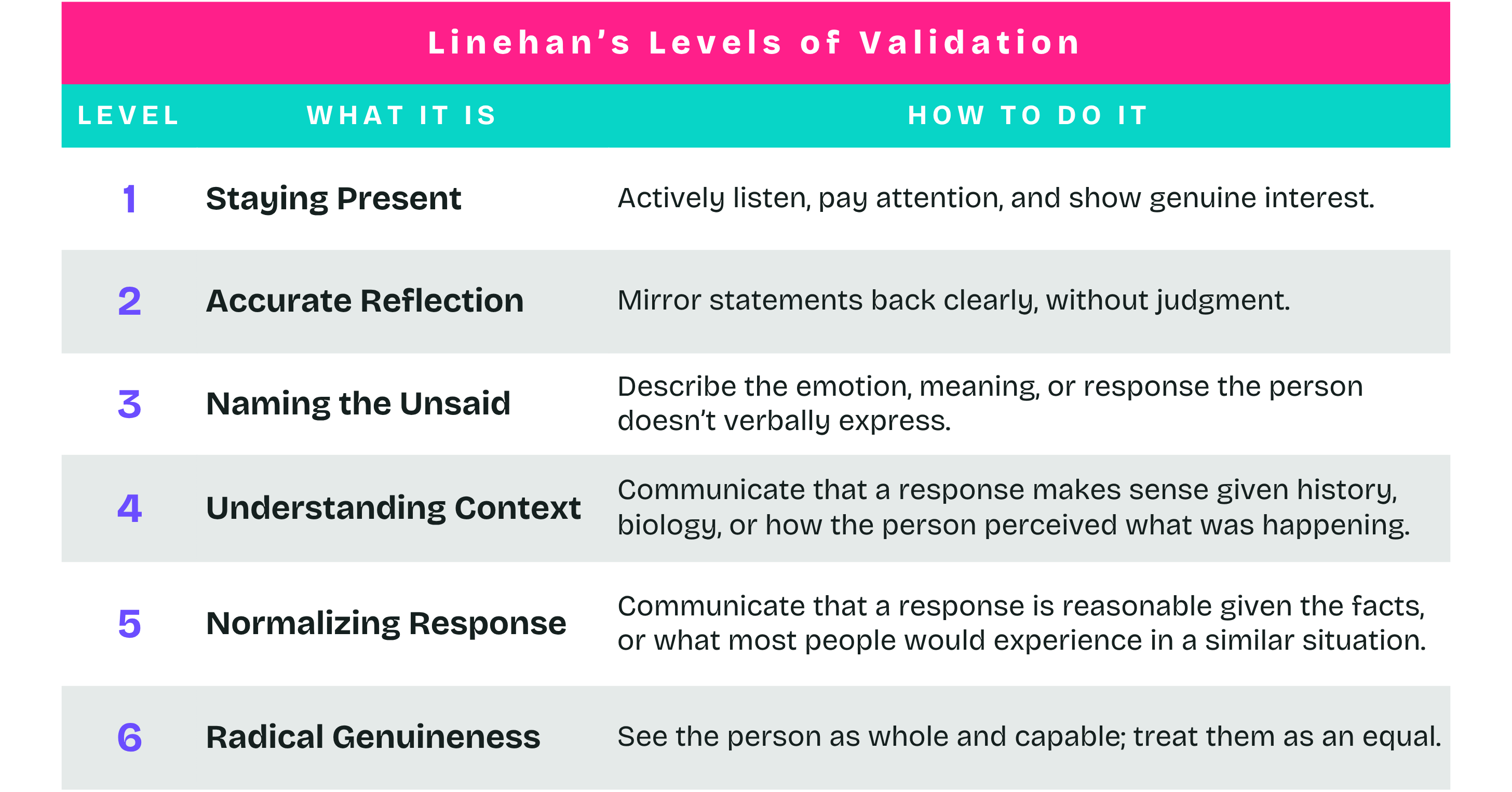
Providing validation involves questioning instead of assuming. It looks like asking what someone wants before you give it – validation or problem-solving – and following their lead on what to do next. And when you forget to ask, name it and repair. You know what mine looks like.
Opening up, saying the hard thing, and asking for help all make us vulnerable to outcomes we cannot control. Validation can make the risk feel more tolerable. When we expect invalidation, we’re tempted to avoid what feels threatening. That avoidance offers momentary relief, increasing the likelihood we will avoid again.
When we express understanding, shame – the emotion that often intensifies avoidance – takes up less space. This can reduce the defensiveness that might otherwise emerge when we suggest behavior is problematic. Validation can help us feel worthy, imperfections and all.
Actively listening to accurately validate can help create what Amy Edmondson describes as team psychological safety. And, that climate gets built in smaller interactions over time – moments when people can share information, challenge assumptions, acknowledge mistakes, and correct course without expecting judgment or punishment. Without the perception of safety, people withhold information, thinking narrows, and decisions stall.
Shifting from being right to being curious, and demonstrating that in action, can decrease the fear associated with vulnerability. While the fear doesn’t disappear, even an incremental decrease opens more space for people to approach what they otherwise might avoid. And the less we avoid, the more we can confront, and effectively navigate, the facts.
I think psychological safety and vulnerability are reciprocal. What happens after someone says the hard thing influences whether they’ll say it again. Validation can make that more likely by lessening shame. And that repeats – in how we live, love, and lead.