


Change is arriving faster than most of us have the capacity for. I keep hearing about the growing importance of developing emotional intelligence, regulating our nervous systems, and building the tolerance to stay with discomfort and hold paradox.
These themes show up across domains – in conversations about organizational leadership, athletic performance, interpersonal communication, self-improvement – just in different languages. People are craving skills that help them do better at being human, whatever the category: to find meaning, feel valued, and live with purpose.
Solutions are offered all the time. Pause before responding. Name the tension. Reflect on your behavior. Act in accordance with your values.
All are useful. And, I keep noticing that how we develop the capacity to actually do them is missing.
Behavioral science offers the how. It gives behaviorally specific tools, backed by decades of research, that can be developed, practiced, and refined. Dialectical Behavior Therapy (DBT) is one well-established example of what behavioral science provides.
So I have to wonder: if the how already exists, why aren’t more of us reaching for it?
I think it’s partly because behavioral science is unglamorous. It asks for learning, practice, and feedback in the messy places that reveal what makes us human. Change happens slowly, and the results aren’t linear. There isn’t an endpoint at which we have ourselves completely figured out.
I also think it’s because of where behavioral science lives. Many of the evidence-based mechanisms for developing regulation capacity are written in academic language and taught inside clinical systems. Some of the most developed tools are concentrated there, so people often encounter them only after something has gone wrong in a clinically significant way. When the entry point is pathology, people either can’t access the tools that might help or don’t see them as relevant.
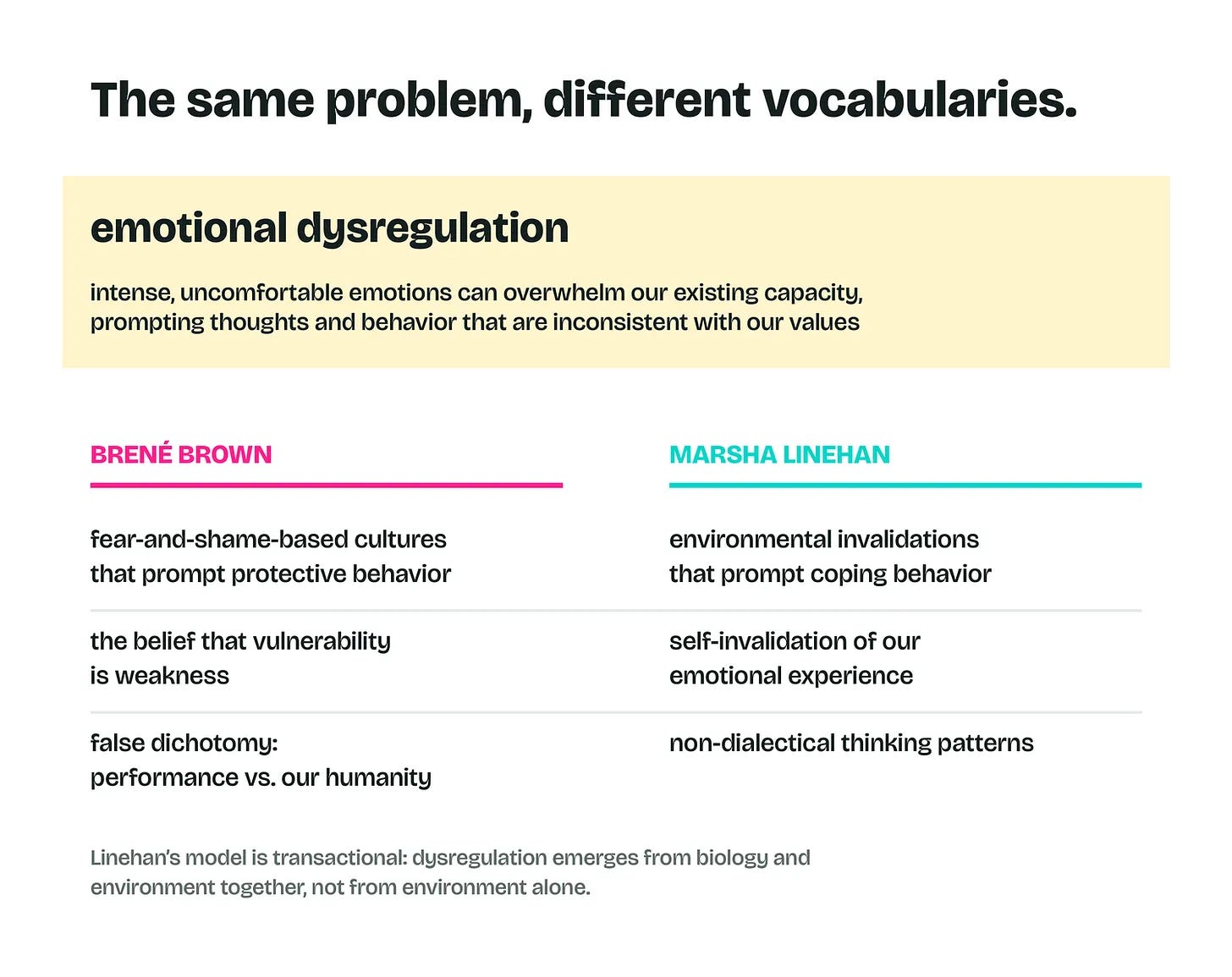
In her most recent book, Strong Ground, Brené Brown claims that collectively, humans feel disconnected, distrustful, and emotionally dysregulated. She defines dysregulation as being “overwhelmed by big feelings that are hard to name and contain and can drive behaviors and thinking that are not always aligned with who we want to be” (p. 22).
Brown states this is fueled by fear-and-shame-based cultures that prompt protective behavior, the belief that vulnerability is weakness, and false dichotomy between performance and our humanity. She argues that strong ground, in ourselves and our connection to others, is what allows for both accepting uncertainty and embracing change.
Her description is remarkably close to the behavioral model I’ve spent my career working within. DBT views emotion dysregulation as the result of transactions between biology and environmental invalidation that prompt coping behavior, self-invalidation, and non-dialectical thinking patterns. Brown’s definition of vulnerability – “the ability to recognize and regulate the emotions we experience during times of uncertainty, risk, and emotional exposure” (p. 23) – is regulation capacity under pressure. She calls this the source code for courage.
Brown names the destination and gives practices for getting there. She also notes a common mistake: building on old dysfunction rather than revamping the foundation. What DBT adds is decades of research on how to develop that core capacity – which skills, in what order, and whether they produce change that holds under pressure.
I think Brown and Linehan are describing the same problem from different angles.
Both were shaped by integrating scientific rigor, personal experience, and contemplative practice.
Part of what obscured the overlap, I think, is the terminology. The mechanisms Brown points toward still live inside clinical literature that pathologizes. Brown deliberately avoids that language because shame gets in the way of change. Bringing these bodies of work together can help close the gap between knowing what to do and being able to do it, especially under pressure.
Linehan’s work was not built around the idea that something was fundamentally wrong with people. She developed DBT to address what happens when a person’s regulation capacity is chronically overwhelmed by environmental demands. She used a systems perspective to name the many things that influence behavior.
Then she needed grant funding and had to select a specific diagnosis as the target. An NIMH reviewer thought Linehan was treating Borderline Personality Disorder (BPD). She didn’t know much about it at the time, and a team member said the connection made sense.
That history linked DBT to a highly stigmatized diagnosis, and it’s carried shame by association ever since. Yet Linehan didn’t think of herself as treating a disorder. In her memoir, she said, “I treat a set of behaviors that gets turned into a disorder by others” (p. 304). Her goal was to teach people to be effective. What helps people improve is genuine human connection, practical skills, and validation for who they are.
Linehan’s model is transactional. Behavior emerges from the complex exchanges between a person and their environment. An environment that shames people for expressing emotional vulnerability is invalidating, and can prompt more shame. It reinforces the very thing it discredits. This is Brown’s claim about strong ground in behavioral language.
This is why DBT focuses on synthesizing acceptance and change. The model assumes that people are doing the best they can with the capacity they have, shaped by conditions they didn’t choose. It also assumes that people want to improve, and – at the same time – that they need to do better, try harder, and be more motivated to change. Holding both at once makes change possible without shame.
I’ve spent my career in clinical settings, working with people whose emotional intensity is so great that many clinicians are reluctant to treat them. I’ve helped people change their behavior when everything in their nervous system was pushing them in the opposite direction. And I’ve seen people drastically change their lives, even after many others told them it wasn’t possible.
These skills were developed and refined under extraordinarily difficult conditions. They teach capacities – observing, describing, regulating, tolerating, reflecting – that aren’t unique to any diagnosis. That’s why I feel so passionate about translating them beyond clinical settings. I think they can help all of us become more effective, wherever the setting.
I first encountered Brown through her TED Talk on vulnerability while I was in treatment for an eating disorder. It was the first time someone accurately communicated what I so desperately desired – deep, authentic connection. And, I had no idea how to get there.
Knowing what I wanted gave me something to work toward. Behavioral science gave me the tools to move forward. What changed things was learning the skills and practicing them over and over. Observing the urge to avoid, describing what I was feeling, and choosing to act on my values when my emotions pulled me elsewhere. Then taking the time to reflect and refine my behavior.
I had to do this hundreds of times, and often when I didn’t want to. I haven’t reached the end. The behaviors I want to change have varied over the years, and I continue to practice the skills and refine them based on my current context and goals. Learning to regulate emotions, communicate effectively, and stay present is a continuous process. One that I have to turn my mind toward radically accepting more often than I’d like to admit.
In practice, naming an emotion helps identify what it is urging us to do: shame pushes us to hide, fear pushes us to escape, anger pushes us to attack. From there, we can ask whether the emotion fits the current facts and whether acting on its urge will move us toward the life we want.
Sometimes checking the facts changes the intensity. When it doesn’t, we can deliberately practice acting opposite to what the emotion is urging us to do. With shame, for example, this looks like letting someone we trust see our messiness. When emotional intensity is too high to think clearly, the task changes again: tolerate the distress until we can.
The skills build on one another. That’s the how. They’re how I built the life Brown helped me imagine.
Reading about these skills can’t replace structured practice, accountability, or feedback. And, I’m increasingly convinced that formal settings aren’t the only place learning can happen. We can practice and refine these skills alongside trusted people in our lives. What’s necessary is curiosity about how to do better at being human and tolerance for receiving feedback that helps us grow.
Feeling overwhelmed by what your environment demands, and then behaving in ways inconsistent with your values, is what DBT was built to address. And, it happens to sound like the description of being a human right now.
The how exists.
It’s backed by science, teachable, and available in places most people don’t think to look. It needs language that doesn’t start with what’s wrong with you.