


Between resigning from my job and pursuing an MBA, I’ve received a lot of questions about what I want to do with my career moving forward. I’ve noticed shame when responding honestly with “I don’t know” and felt pulled to “figure it out.”
I put pressure on myself to try to formulate some beautifully crafted answer that merges my experience, interests, and capabilities. This made confronting the reality that I really don’t know more anxiety-provoking.
The truth is that I didn’t go back to graduate school with a specific career path in mind. It’s something I’ve considered for a while out of curiosity, I have the time and energy for it, and I enjoy learning. Resigning from my job was similar. I didn’t have a formal next position lined up and just felt ready to move on and try something new.
Both moves were experimental. They’re taking me outside of my comfort zone to test new dance moves, see what they feel like, learn what doesn’t jive, and iterate on what does. That doesn’t mean each didn’t provoke fear (they definitely did). I’m now noticing and accepting its presence without letting it take the lead.
Admittedly, I spent the first few months this fall listening a little too much to my fear. Looking back, I see how attempting to preemptively identify some outcome limited my curiosity, and ironically, increased distress. Doing that caused me to hyperfocus on the destination, which pulled my attention from the present moment.
The frustrating part is how well I know this and struggle to put it into action (yes, the same knowing-doing gap I keep talking about). The more we focus on what could have been, or what can be, the more we miss out on what is. We can’t change the past, the future remains uncertain, and all we have is now.
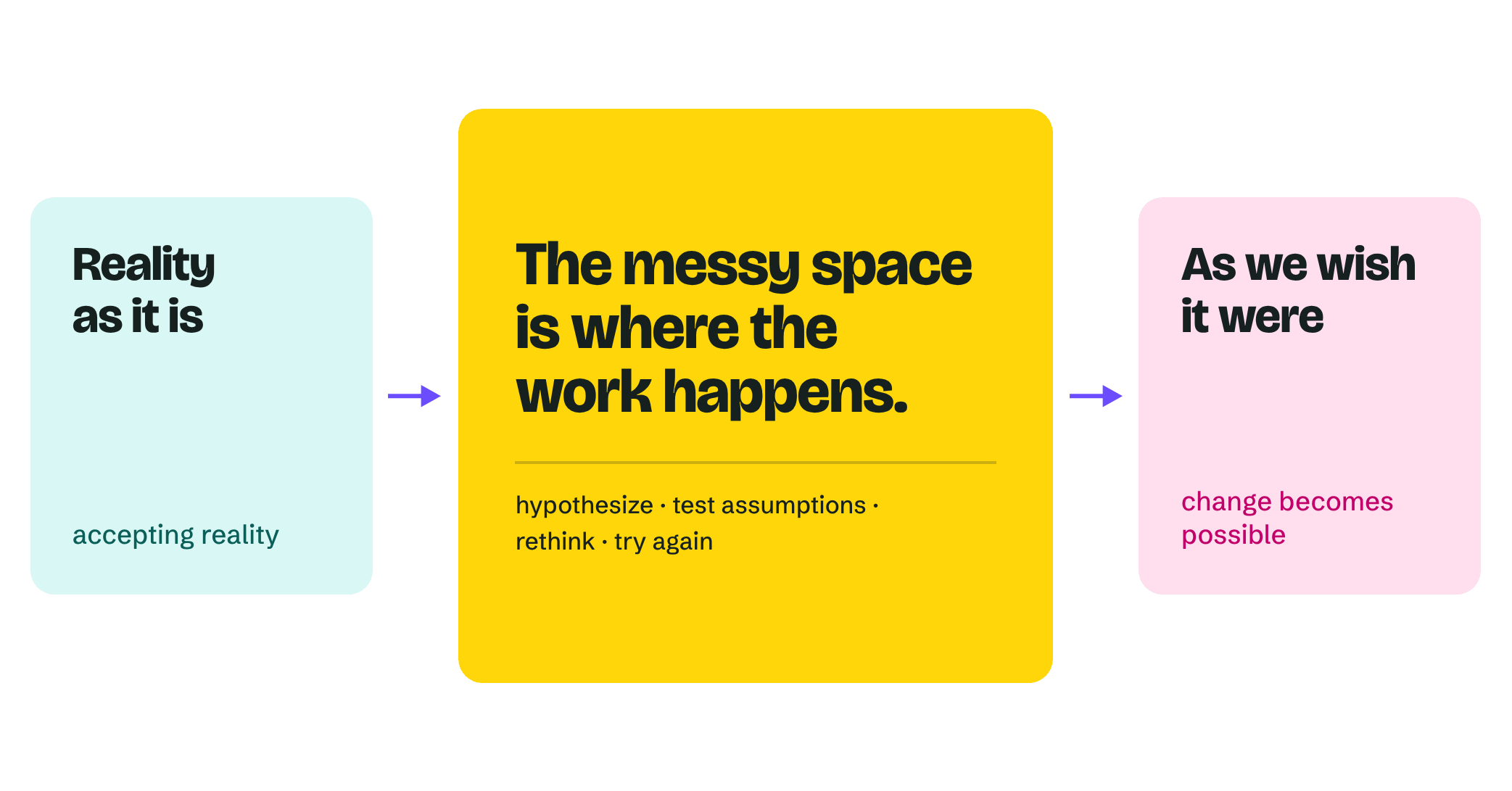
We get attached to outcomes – ones we want, and often, ones others tell us to want. This makes sense – it allows us to avoid the messy space between reality as it is and as we wish it were. And, that attachment inhibits our focus on the journey.
Society models and reinforces this hyperfocus. We’re supposed to know what major we want to pursue, for what reason, and for what career when our prefrontal cortexes are still developing. And, we talk about this outcome as if there’s only one – that once we make a decision about a career path, we’re locked in. The fact is, however, that careers (just like life) aren’t that linear.
To clarify, there’s nothing wrong with knowing what you want to be when you grow up and taking steps to get there. The problem emerges when something impedes the path. Fighting reality will stunt forward movement as you keep trying to change what can’t be undone. Accepting it will allow for effective action as you respond to the facts.
That’s the hard part. Accepting what’s in front of us when it’s painful. And, this is the part of the process that is the most critical. What makes us uncomfortable is also what makes effective change possible.
Thinking like a scientist can enhance our willingness to accept the facts and embrace discomfort. It approaches uncertainty using evidence, investigation, and adaptation. It remains open to rethinking beliefs when new data appear.
When problems emerge, rather than deny an unpleasant truth, a scientist remains curious and nonjudgmental about alternative perspectives. Learning and deeper understanding are pursued over perfection – because focusing on being right teaches us very little.
The messy space we try hardest to avoid is where we can experiment – it’s where we hypothesize, test assumptions, rethink, and try again. It’s where growth starts.
That’s how I’m now approaching my own experiments. Instead of forecasting the outcome, I’m following my curiosity and observing what gives me energy. I’m noticing how much I enjoy connecting seemingly disparate information – like DBT and leadership – and generating novel questions, although I’m still uncertain what this means for my career. The fear remains, and, excitement is more prominent.
Experimentation itself is often messy, and ideal results are rarely achieved on the first try. Avoidance of the results keeps us stagnant; trying new methods of interacting with them, and being willing to make mistakes, is how we adapt. Practicing new dance moves when the situation shifts is how we build mastery.
If we view uncertainty as an opportunity for experimentation, how might that influence the way we approach change?
The only constant in life is change, so focusing too much on the outcome can set us up for long-term disappointment. When we focus more on the journey, the outcome can become the side effect of attending to the present.
Actively building a life worth living is what makes life worth living.
Now when someone asks what I want to be when I grow up, I’m more comfortable answering honestly with “I don’t know.”
Enjoyed reading this, thanks for sharing your journey. As someone who also recently quit a job to pursue consulting, I can relate! I love your point about focusing on outcomes. I think it can lead to many negative consequences and increased fear of failure. It's difficult, but I've found that focusing on the process or a greater purpose can help shift focus away from outcomes.