


When I started working with children and adolescents in graduate school, one of my biggest frustrations was watching them work hard to change while patterns in the system around them kept pulling them back – a part of the problem I was unable to touch.
So when I learned Family-Based Treatment (FBT) on my predoctoral internship, I loved it. I finally got to work with the whole family unit. I saw what the research supports: involving families can make lasting change more likely.
Over the course of my career, I’ve continued to work with individuals more than families. And, the work that I’ve done with families sometimes feels more impactful. The challenge is that many families are reluctant to engage in therapy, preferring that only the individual with the “problem” receives help.
I get that completely. Going to therapy often feels like you must be doing something “wrong.” And, I wish more people would challenge that. Many of the families I work with are doing plenty of things right. The things they are doing “wrong” usually aren’t intentional – they’re functioning in ways they think will help. And in the moment, these behaviors typically are beneficial. It’s in the long term when the unintended consequences show up.
A classic example in my work with eating disorders is when kids express anxiety around eating. A parent’s natural response is to protect their kid from discomfort, so they don’t push them to eat more. This temporarily quells their child’s discomfort, and, reinforces food avoidance – making it more likely next time.
What starts as a form of protection unintentionally results in dysfunction. Both are true at the same time.
By the time the child, or family, comes to see me, the fear around food is at an all-time high. And the recommendation I have to give the family? Make your kid eat. Have them do one of the things they fear most. Watch someone you love suffer through a meal. Let me tell you – this is quite unpleasant for all parties involved (myself included).
I don’t blame parents for someone developing an eating disorder. Ever. I name the function within the dysfunction, which reduces shame. Parents still express guilt around the situation. And that distinction is important – shame is about who you are, guilt is about what you do. I keep providing relentless validation that the eating disorder is not their fault.
I’m walking you through this example because family, team, and organizational norms shape individual functioning. Working only at the individual level leaves part of the problem untouched. Lasting change requires the system to change with the person.
This is why I find family work so fulfilling. It’s why I feel passionate about broadening the scope of my impact. And why systems thinking is critical for meaningful change, whether it be at home, at work, or in your organization.
I’ve learned this as a leader as well. I’ve spent plenty of time reflecting on my leadership behavior outside my team – with the executives, my therapist, and my partner. And, a shift came when I explicitly asked my team for feedback.
They gave me information I couldn’t access alone: how they experience me in the room. Their responses offered specific things to work on. Without that data, I had to assume. With that data, I was able to act effectively.
I was working on my leadership everywhere except inside the system where it was happening. I still wonder why I didn’t ask earlier.
In both family work and leadership, the task begins by asking the people inside the system. It’s what I learned while designing community interventions in graduate school, and a practice I’m forever strengthening.
Systems thinking is foundational to a dialectical worldview.
The principles include seeing reality as a complex system of many interacting parts and recognizing that humans are in a constant exchange with their environment. Fully understanding human behavior requires considering the larger systems that shape how someone experiences the world. The parts only make sense in relation to the whole.
And. These parts often pull against one another. A dialectical philosophy holds that reality is made of seemingly opposing forces, and the tension between them produces change. In family systems, a parent’s instinct to protect their child from distress can pull against what recovery requires – two forces moving in opposite directions, even when both are rooted in care.
The biosocial theory in DBT makes this systems approach clearer. It explains how behavior is shaped by individual and environmental factors, and how they interact over time.
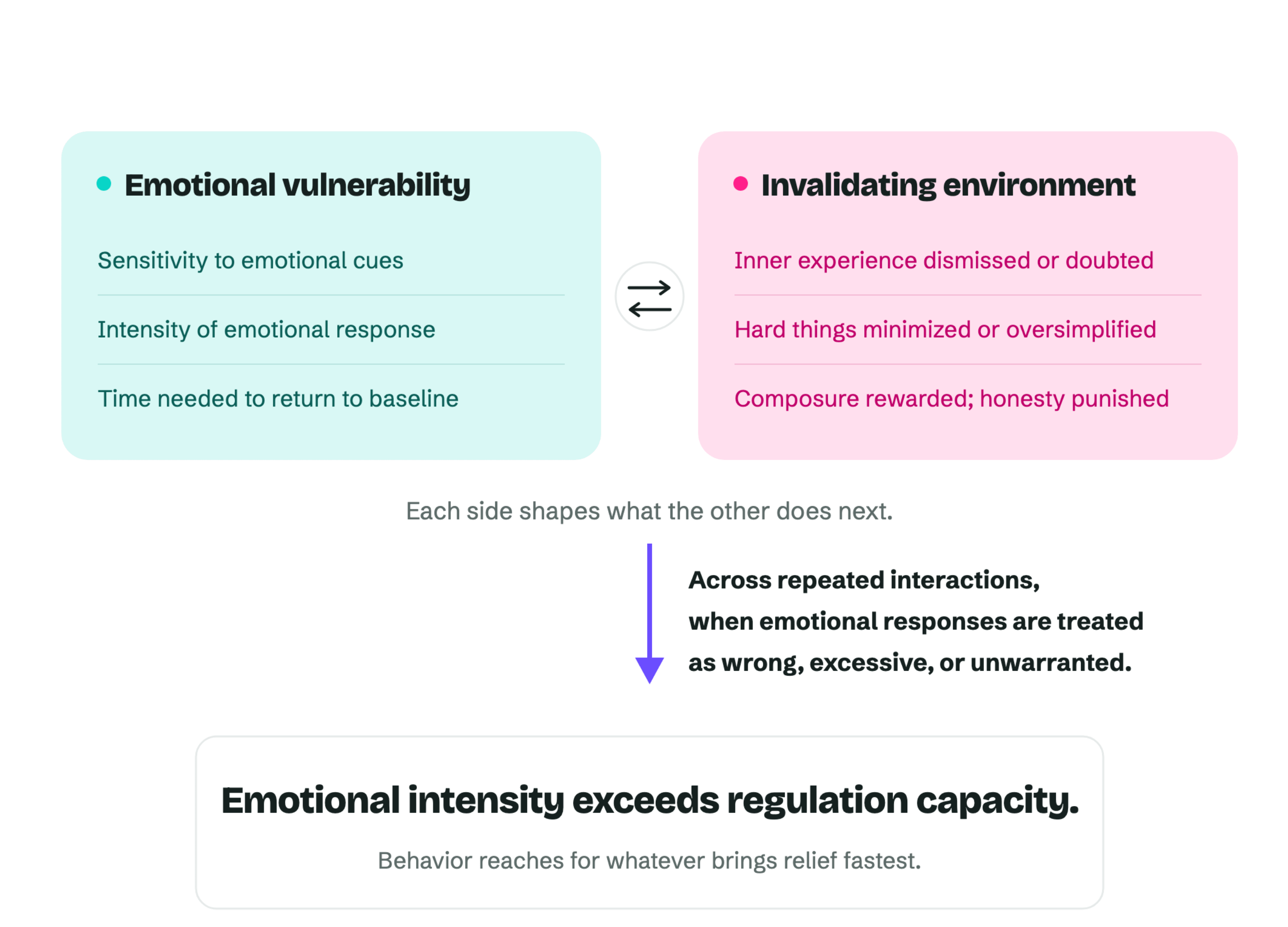
The transaction between biological vulnerability and invalidating environments contributes to emotion dysregulation. Invalidation can be subtle, unintentional, and invisible to the person doing it. It doesn’t require trauma or intentional harm.
It can happen when temperament and environment are mismatched, and a person gets the message that their experience is wrong, excessive, or unwarranted. With eating disorders, diet culture is a classic example of an invalidating environment. It says your hunger, fullness, and bodily signals can’t be trusted. It rejects your internal experience and makes you look outward for guidance.
This is why simply saying “just eat” rarely works on its own. It goes against what someone experiences physiologically and psychologically. Paired with validation, however – that eating is unpleasant, the difficulty isn’t their fault, and they have to do the hard thing anyway – the instruction can become easier to hear and act on.
Understanding behavior requires curiosity about what individual explanations often miss: the current environment and social, economic, and political context shaping someone’s perspective.
It requires asking how behavior functions within the system someone lives in.
When I remain curious about function and set aside my automatic assumptions, I’m able to piece together why certain behaviors make sense. And when I communicate this understanding, I offer validation to whoever I’m working with. Naming the why makes individuals, and their family members, more open to doing the hard work of changing behavior that was protective in the past.
Validation and being nonjudgmental often increase the willingness of supporters to participate in family work. And, the cultural attitude that therapy is for people with “problems” keeps many away from receiving help.
I understand this as a barrier. It’s another systems-level aspect that needs attention.